Our Son Is In His Head
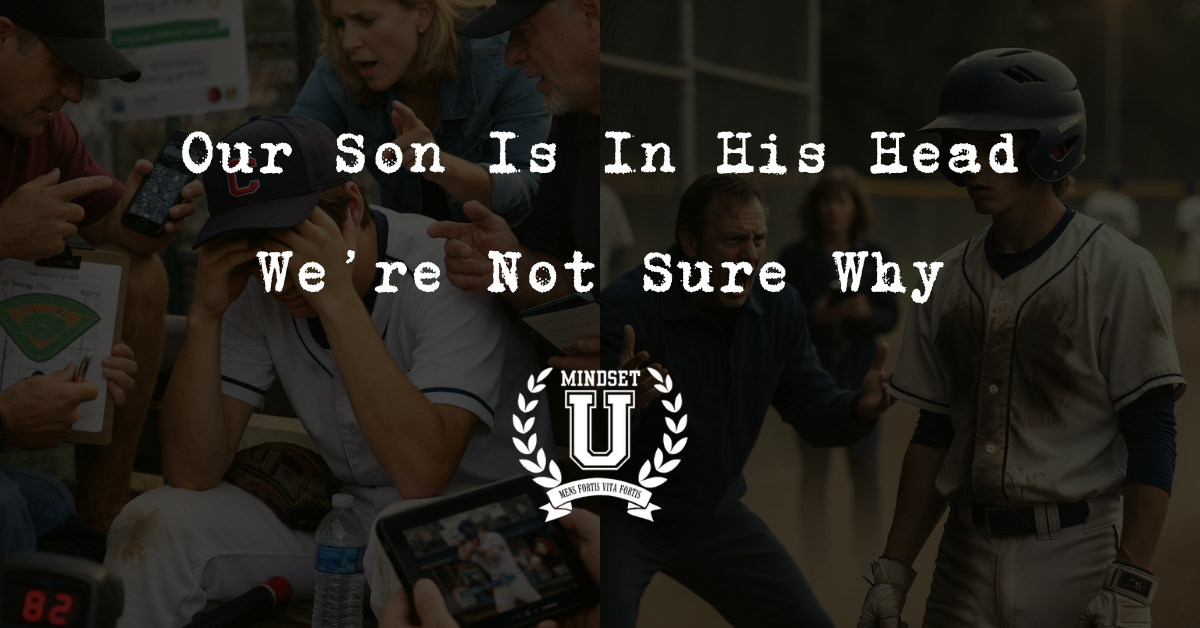
A baseball parent email classic. Also, often a lie.
Every coach, private instructor, “mental performance specialist,” and radar-gun philosopher in a quarter zip has read this email:
“Hi Curtis,
We’re interested in discussing options for our son.
He’s really in his head right now.
Confidence is low.
He’s pressing.
We think he could really benefit from your work.”
I read it.
I reply.
Clear. Direct. Honest. No guru fluff. No fake-athlete Instagram quotes over a black-and-white photo of a dugout.
And then...
Nothing.
No reply.
No follow-up.
No booking.
No “Thanks, we’ll think about it.”
No “We accidentally spent the money on another showcase and a custom bat grip.”
Just silence.
Which always leaves me with the same thought:
Is the player actually in his head?
Or did the adults finally run into a mirror and quietly back away from it?
Because a lot of these emails are not really requests for help.
They’re fishing expeditions.
Parents want to know if there’s a way to get the kid better without anyone in the environment having to change.
That’s the dream.
That’s also why nothing changes.
Maybe I Shouldn’t Say This
Maybe I shouldn’t call people out.
It’s probably not “good for business.”
Maybe I should soften it.
Smile more.
Use nicer language.
Write one of those safe little posts where everybody feels “seen” and nobody feels exposed.
That would probably be smarter.
But reality is this:
I will never get hired by people who need a version of the truth that fits their narrative.
And honestly, that’s fine.
Those are not my people.
The people I work best with, and the people who actually change, are usually the same type:
humble
curious
honest
and usually quite bright
They don’t need to be coddled.
They want clarity.
They can handle being challenged.
They are actually willing to look at the system instead of just blaming the symptom.
And that matters.
Because if you want real change, you have to be willing to see what’s actually there...
not just what protects your ego.
The Great Youth Baseball Scam
Most people are not developing players.
They are managing optics.
That’s the real conversation.
A lot of youth baseball today is not about development.
It’s about:
appearance
status
social positioning
perceived advancement
emotional outsourcing
The kid is not always the athlete anymore.
Sometimes he’s the family stock portfolio.
And nobody wants to admit they’re checking his value more than they’re actually watching him play.
Every game becomes a quarterly earnings report.
Did he hit?
Did he pitch?
Did coach notice?
Did the scout notice?
Did someone post it?
Did another parent see it?
Are we still “on track”?
Is he “behind”?
Should we switch teams?
Should we get another hitting coach?
Should we get a mindset coach?
Should we panic in the car or wait until dinner?
This is not player development.
This is adults tying their identity to a kid’s performance and pretending it’s about the kid.
The Baseball Family Magic Trick
Here’s how this usually works.
A player starts pressing.
He’s overthinking in games.
Looks tight.
Body language is off.
Starts doubting himself.
Can’t transfer practice into games.
Gets emotional after failure.
Needs every at-bat to mean too much.
And everyone says:
“He needs help mentally.”
Maybe.
But maybe he also has:
4 adults talking mechanics every car ride home
Instant feedback from data he doesn’t need
2 private coaches texting swing thoughts
a dad checking GameChanger like it’s the stock market
a mum asking “what’s wrong?” every time he goes quiet
a family group chat breaking down every at-bat before the kid’s even out of the parking lot
and a house where baseball is not a sport anymore…
…it’s a courtroom.
But yes.
Let’s send the kid to work on “confidence.”
That should do it.
EQ-OS and the Lie of “Confidence”
Let’s say this properly.
Most kids described as “in their head” do not have a confidence problem.
They have an operating system problem.
More specifically:
Their awareness has outpaced their capacity.
That’s the whole issue.
And that’s why most of the advice in baseball does not work.
Because confidence is not the root variable.
Capacity is.
In EQ-OS terms:
Outcome = Awareness x Capacity
If a player becomes more aware of:
pressure
failure
expectation
comparison
consequence
data
…but does not have the nervous system, emotional range, or cognitive control to carry that awareness cleanly…
he collapses.
That collapse gets mislabeled as:
overthinking
low confidence
mental weakness
“being in his head”
But what you’re actually watching is:
high awareness with low usable capacity.
That’s why some players get worse the more instruction they receive.
Because you are not helping.
You are adding awareness to a system that cannot metabolize it.
That is not coaching.
That is flooding.
Now Add the COVID Kid Era
We are not approaching this.
We are in it.
This generation was shaped by:
restriction
surveillance
dependency
interruption
and an adult world obsessed with control
So they missed reps in:
autonomy
discomfort
conflict
boredom
failure without rescue
Now they show up with:
low frustration tolerance
weak internal stabilizers
poor independent decision-making
a shaky relationship with discomfort
And then baseball does what baseball always does:
It exposes the nervous system.
It asks:
Can you stay available after failure?
Can you think under ambiguity?
Can you recover after embarrassment?
Can you regulate without reassurance?
And a lot of them can’t.
Not because they’re weak.
Because they were protected from building it.
The Baseball Parent Paradox
“We need help.”
“But not like that.”
A parent reaches out.
Then immediately negotiates the work.
“We were thinking maybe one call a week should do it.”
Of course.
Because a nervous system that’s been overloaded for years clearly just needs a weekly chat and a deep breath.
That’s like saying:
“My engine is on fire, but I think one oil change should do it.”
And the best part?
This comes from people with no framework for pressure, behaviour, or regulation…
…who still feel qualified to redesign the process.
Because what they’re really saying is:
“We want the result. We just don’t want the disruption.”
And just for clarity:
I’ve been where your kid says he wants to go.
And I work with players trying to stay there.
That matters.
The Coaching Crisis
Baseball is full of adults building résumés off children.
There is a coaching crisis.
It’s not subtle.
It’s structural.
A lot of baseball coaching is just adult identity repair disguised as player development.
And it shows.
Victoria Baseball and the Cult of Looking Legit
Let’s make it local.
This is part of why I don’t spend much time working in Victoria.
Not because there aren’t good people here.
There are. Amazing people!
But there’s also a version of baseball here that is brutal for real development.
You know the type.
The coach with:
early-work Arizona Fall League bucket hat energy
Pit Vipers on before the sun’s fully up
a title bigger than his understanding
a network bigger than his actual value
way too much Driveline gear
and a bio written like he’s one coffee away from running a major-league front office
Meanwhile the parents are down the line:
full Lululemon
phones out
GameChanger open
filming every swing
zooming in
rewinding
texting mid-inning
Like it’s a live trading floor.
But put that same group in front of a struggling 16-year-old…
And nobody actually knows what they’re looking at.
Because:
They don’t understand behaviour.
They understand aesthetics.
And the scary part?
Most of them think they’re helping.
And baseball has become infested with it.
Good swings.
Clean edits.
Hard throws.
Polished branding.
And words.
Words they heard Mark DeRosa say on MLB TV and now repeat like they’re running a front office meeting:
“Work.”
“Coil.”
“Grind.”
“Pronate.”
“Intent.”
“Sequencing.”
“Development.”
“Be uncommon.”
And my personal favourite:
“HIGH PERFORMANCE.”
Nobody can define it.
Everyone says it.
Meanwhile the player still can’t:
handle failure
slow the game down
think under pressure
recover after getting exposed
Because none of that shows up in a clean edit.
What We Replaced Without Noticing
We traded development for presentation.
We traded reps for content.
We traded failure for filtering.
We traded dirt for lighting.
We traded coaching for vocabulary.
And somehow we called that progress.
Bring Back Baseball
You know what used to work?
A dad in jeans and a hoodie.
Glove on one hand.
Short bat in the other.
Hitting ground balls tennis style.
No brand.
No system.
No hashtags.
No “intent.”
Just:
reps
mistakes
adjustments
and a kid learning how to deal with the ball not going where he wanted it to
No breakdown.
Just another rep.
The Car Ride Home
Still undefeated.
The most consistent confidence-killer in youth baseball.
Kid gets in the car.
Still sweating.
Still processing.
And before he can breathe:
“What were you thinking in that at-bat?”
“You guys looked flat.”
“Did you hear about Johnny’s Dad?”
“Why didn’t you swing?”
“Coach didn’t look happy.”
“When I played…”
That’s not support.
That’s interrogation.
Of a dysregulated nervous system.
Five minutes after failure.
What he needs is decompression.
What he needs is chicken nugs and silence.
But silence feels like loss of control.
So parents fill it.
And then wonder why the kid shuts down.
What You’re Actually Watching
Is not a baseball problem.
It’s a systems problem.
Baseball piles on:
failure
delay
ambiguity
embarrassment
repetition
It’s a regulatory stress test.
And baseball does not expose character first.
It exposes capacity.
What Real Mental Performance Work Actually Is
Signal → Check → Stabilize → Close → Train
That’s the work.
And no kid out-regulates a chaotic environment.
If this post feels exaggerated to you, it’s probably because you’re inside it.
Final Thought
Your son may not need more confidence.
He may need less interference.
Because in the end:
A lot of players are not failing baseball.
They are failing adult interference.
And if that bothers you?
Good.
It means we’re finally near the truth.
If you’re a parent or player reading this thinking,
“Dangit… this is us,”
then good. That’s where real work starts.
If you want to go deeper, start here:
The Book
That’s where I lay out the full EQ-OS framework, pressure, regulation, capacity, and why so many players are being coached at the wrong layer.
The 30-Day Intro Program
If you want to actually do something instead of just nodding at another post, this is the best place to begin.
Simple. Direct. Built to create real awareness, structure, and traction fast.
Because most players do not need more hype.