The Mental Performance Industry Talks Too Much
I’m not trying to be a hater here.
A lot of the people in the mental performance space are good people. Some are ex-pro guys. Some have been in baseball forever. Some genuinely care.
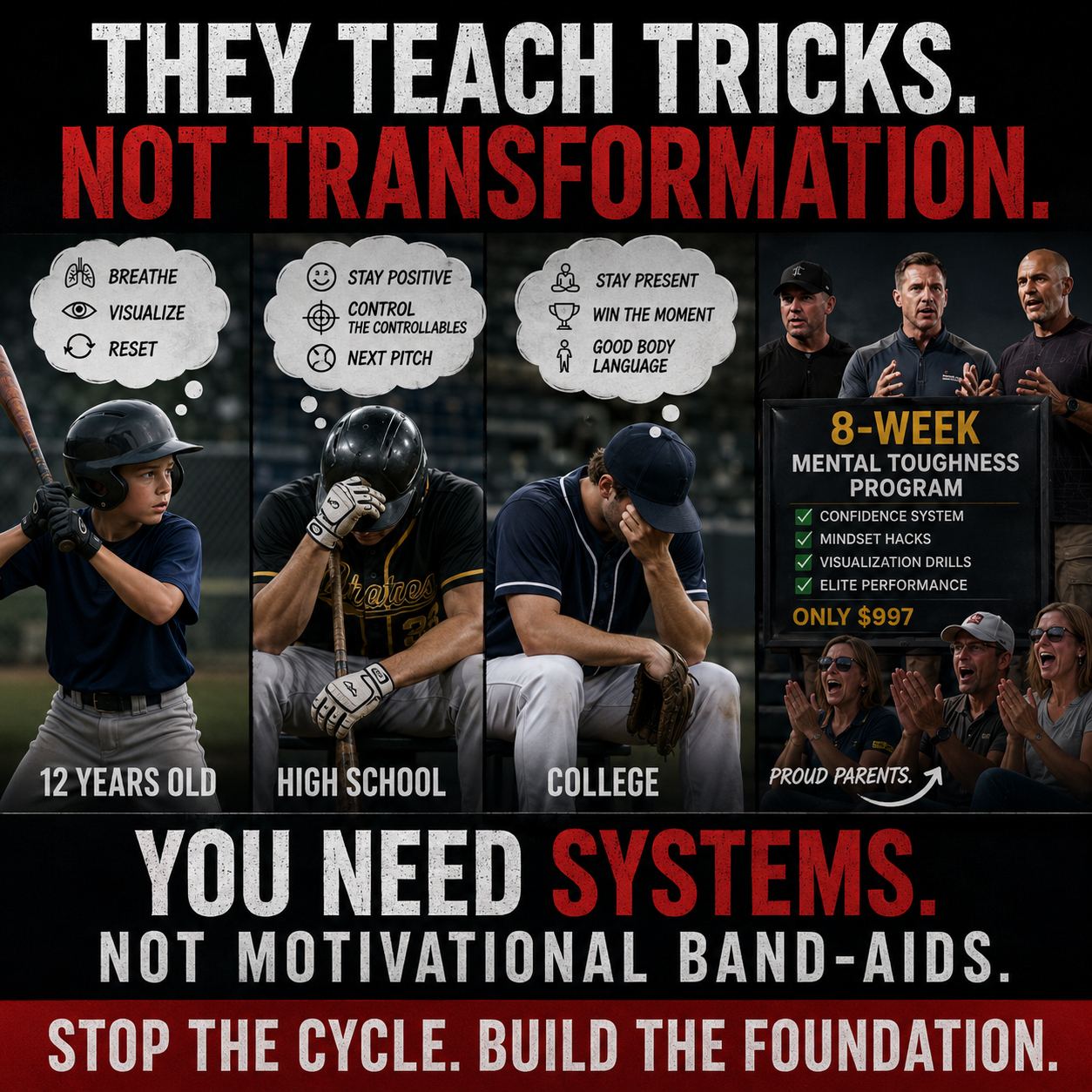
But these words need to be said because we are getting dangerously close to another industry selling 8-week “mindset” programs to 12-year-olds that college players still can’t consistently implement.
That should bother people.
Because somewhere along the way, monetization started beating implementation.
And those are not the same thing.
I keep seeing:
confidence courses
breathing systems
reset protocols
visualization packages
mindset programs
mental toughness packages
…being sold to kids who:
sleep five hours
are addicted to screens
have no structure
cannot regulate emotions off the field
have zero behavioural accountability
cannot manage pressure
cannot sit still
have identity attached entirely to performance
But somehow we’re pretending another acronym is going to save them.
And look, breathing matters.
Awareness matters.
Emotional control matters.
But I think the industry has become obsessed with managing effects instead of identifying causes.
Band-aids instead of reconstruction.
But, I digress.
Here’s my thoughts.
“Modern man can’t see God because he doesn’t look low enough.”
Carl Jung.
That might be one of the most important lines ever spoken about performance, discipline, masculinity, growth, and human behaviour.
Because everybody today is looking too high.
Too obsessed with outcomes.
Too obsessed with motivation.
Too obsessed with hacks.
Too obsessed with image.
Too obsessed with confidence.
Too obsessed with success.
Too obsessed with “making it.”
Meanwhile the answers are usually sitting right at your feet.
Your sleep.
Your habits.
Your routines.
Your discipline.
Your standards.
Your attention.
Your environment.
Your emotional control.
Your behaviour when nobody is watching.
That’s what Jung meant.
Modern people want transformation while stepping over the tiny behaviours that actually create transformation.
Everybody wants:
confidence
success
money
the scholarship
the body
the relationship
the business
the identity
Very few want the repetition attached to those things.
A kid says:
“I want to play Division 1 baseball.”
Okay.
But:
his room is chaos
his sleep is chaos
his screen time is chaos
his emotional regulation is chaos
his routines are chaos
his attention span is fried
his preparation is inconsistent
his recovery is terrible
his habits are weak
But he wants the massive outcome.
That’s modern performance culture.
Everybody looking high enough for greatness while refusing to look low enough at behaviour.
And last night talking with Tacoma Community College, this was the entire conversation.
Everybody wants confidence.
Everybody wants results.
Everybody wants to feel locked in.
But almost nobody wants to become the person required to hold those things consistently.
That’s the game.
Everybody wants to hit .370.
Very few want the boredom, discipline, repetition, failure, loneliness, obsession, sacrifice, emotional regulation, structure, and precision attached to becoming the guy capable of hitting .370.
People love outcomes.
They hate transformation.
Because transformation is ugly.
It’s repetitive.
Embarrassing.
Humbling.
Slow.
Frustrating.
Boring.
You fail.
Then fail again.
Then improve slightly.
Then regress.
Then doubt yourself.
Then stabilize.
Then break again.
Then slowly become more capable.
That’s real growth.
Not motivational reels.
Not “alpha” clips.
Not fake confidence speeches.
In order to defeat monsters, you usually have to become a version of one yourself.
Not abusive.
Not reckless.
Not unstable.
Dangerous.
Disciplined.
Focused.
Precise.
Relentless.
Capable of suffering voluntarily.
Every person you admire became obsessive somewhere along the line.
Michael Jordan.
Kobe Bryant.
Tom Brady.
Tiger Woods.
David Goggins.
Jocko Willink.
Alex Hormozi.
Absolute monsters.
Because greatness requires a willingness to walk directly into discomfort repeatedly while everybody else searches for comfort.
That’s the difference.
Most people today are soft because the world rewards softness temporarily.
Convenience.
Distraction.
Entertainment.
Dopamine.
Scrolling.
Excuses.
Comfort.
Victimhood.
Instant gratification.
And the scary part?
Your brain loves all of it.
Your brain is not designed for greatness.
Your brain is designed for survival.
Which means your brain constantly says:
stay safe
conserve energy
avoid embarrassment
avoid pain
avoid failure
avoid uncertainty
Maybe that’s your monster.
Maybe your monster is comfort.
Maybe it’s distraction.
Maybe it’s laziness.
Maybe it’s fear.
Maybe it’s insecurity.
Maybe it’s addiction to approval.
That’s why people stay stuck.
Because they avoid the confrontation required for transformation.
So how do you become the stronger monster?
That’s the real question.
How do you become:
the disciplined one
the dangerous one
the composed one
the one capable of walking directly into chaos voluntarily
Not through motivation.
Through repetition.
Through standards.
Through precision.
Through suffering chosen voluntarily.
Through behaviour repeated long enough that it becomes identity.
Everybody’s great when they’re comfortable.
Everybody feels dangerous:
rested
motivated
emotionally stable
inspired
confident
Champions are revealed when they’re:
tired
embarrassed
doubting themselves
overwhelmed
distracted
alone
uncomfortable
That’s where the real competitor appears.
And this is where young men get lost today.
Because we live in a culture that often confuses masculinity with toxicity.
Not toxic masculinity.
Real masculinity.
Responsibility.
Discipline.
Control.
Courage.
Protection.
Leadership.
Restraint.
Sacrifice.
Young men need challenge.
They need missions.
They need standards.
They need difficult things to climb.
Give a young man comfort without purpose and watch what happens:
anxiety
addiction
distraction
emotional fragility
nihilism
lack of direction
But give him responsibility, challenge, discipline, structure, and purpose?
Different human being.
That’s why hard sports matter.
That’s why hard coaching matters.
That’s why struggle matters.
You do not discover yourself in comfort.
You discover yourself in confrontation.
In suffering.
In chaos.
In pressure.
Not while scrolling motivational clips in bed.
And this is where most people negotiate themselves into mediocrity.
Alarm goes off?
Negotiate.
Workout?
Negotiate.
Diet?
Negotiate.
Sleep?
Negotiate.
Goals?
Negotiate.
Standards?
Negotiate.
Then they wonder why they don’t trust themselves.
Discipline is self-trust repeated.
That’s it.
Confidence is not created through hype.
Confidence is not created through speeches.
Confidence is not created through “believing in yourself.”
Confidence comes from preparation.
Confidence comes from evidence.
You trust yourself because you have proof.
How about this mantra:
do an unreasonable amount of work with extreme precision for an unreasonable amount of time.
That’s it.
Not manifestation.
Not “good vibes.”
Not mindset tricks.
Execution.
Volume.
Reps.
Tracking.
Precision.
Consistency.
Patience.
Do so much quality work that your goals become statistically difficult to avoid.
That’s real confidence.
And honestly, this is where the modern mental performance industry completely loses the plot.
Everybody is selling the same stuff.
Different acronyms.
Different hoodies.
Different thumbnails.
Different podcast clips with dramatic piano music and somebody saying:
“Stay present.”
“Control the controllables.”
“Breathe.”
“Reset.”
“Trust the process.”
Same burger.
Different wrapper.
And somehow the entire industry keeps getting a pass for it.
A lot of these guys are not technically wrong.
That’s the trap.
The information itself is usually decent.
Breathing matters.
Awareness matters.
Emotional control matters.
Routines matter.
But the industry has become obsessed with managing effects instead of identifying causes.
That’s the real issue.
Most mental performance coaching today is psychological Advil.
Temporary symptom relief.
Player nervous system fried?
Teach a breathing reset.
Player anxious?
Visualization.
Player spiraling?
Positive self-talk.
Player overwhelmed?
Mindfulness.
Again, none of this is bad.
But almost nobody stops to ask:
Why is the athlete dysregulated in the first place?
That’s where the entire industry starts falling apart.
Because the real issue usually isn’t:
lack of breathing
lack of affirmations
lack of motivation
lack of journaling
The real issue is often:
dopamine overload
screen addiction
poor sleep
emotional instability at home
identity attached to performance
social pressure
lack of structure
inconsistent routines
nervous system overload
no physical recovery
chaotic environments
poor self-worth
fear-based parenting
overstimulation
zero accountability off the field
But nobody wants to touch that.
Because that requires lifestyle reconstruction.
Not just performance hacks.
And lifestyle reconstruction is harder to sell than:
“3 tips to stay confident at the plate.”
So instead, the industry stays surface level.
Band-aids everywhere.
Nobody asking why the wound keeps reopening.
You see this constantly in baseball.
A kid is emotionally collapsing after strikeouts.
Everybody immediately goes:
breathing exercises
reset routine
focal point
positive cue words
visualization
self-talk
mechanics
Meanwhile the kid:
slept five hours
spent seven hours on TikTok
lives in a pressure cooker environment
has parents tying love to performance
consumes dopamine all day
has zero emotional regulation outside baseball
never experiences boredom
has no structure
cannot sit still
has no recovery systems
has attached identity to stats since age 10
But sure.
Let’s teach him box breathing.
That’s modern mental performance in a nutshell.
Treating the smoke instead of the fire.
And the craziest part?
The industry keeps rewarding this.
The more polished the language sounds, the more people assume it’s deep.
So you get endless recycled phrases:
“Win the moment.”
“Be where your feet are.”
“Dominate the controllables.”
“Reset.”
“Stay neutral.”
“Compete.”
And everybody nods like ancient wisdom just entered the room.
Meanwhile most athletes have absolutely no idea how to actually build emotional stability.
Because emotional stability is not created during the game.
It’s revealed during the game.
Games expose systems.
They don’t create them.
A player who:
sleeps well
trains consistently
regulates emotions daily
limits distraction
has structure
understands failure
has stable identity
has healthy family communication
trains under pressure
builds behavioural consistency
…does not need as many emergency mental tricks during competition.
Because the system itself reduced the leak.
That’s real mental performance.
Not emotional firefighting every inning.
Most mental performance coaches speak in motivational fog.
They say things like:
“Be where your feet are.”
“Trust the process.”
“Win the moment.”
“Control the controllables.”
“Breathe and reset.”
Okay.
But what does that actually mean in the 7th inning after two punchouts and your dad’s pacing behind the backstop like a divorced stockbroker on cocaine?
That’s where the industry falls apart.
Because very few mental performance coaches actually operationalize anything.
They explain concepts.
They rarely build systems.
That’s the difference.
The industry sells motivation instead of nervous system training.
That’s the biggest hole.
Most of these coaches still approach mindset like positive thinking.
But performance collapse is physiological first.
A player isn’t choking because he forgot confidence quotes or a cool acronym..
He’s choking because:
heart rate spikes
breathing changes
vision narrows
muscles tighten
attention fragments
self-monitoring increases
motor patterns degrade
That’s a nervous system event.
Not a motivation problem.
And until coaches understand that, they’ll keep handing out affirmations to kids whose bodies are already in survival mode.
The real game is not motivation.
It’s capacity.
Can the player:
regulate emotion?
stay aware under stress?
recover after failure?
maintain decision quality?
stabilize physiology?
repeat behaviour under pressure?
transfer skill into chaos?
That’s the whole thing. And yes.. I’m repeating this on purpose. Because that’s the point.
Meanwhile the actual issue is:
attention regulation
nervous system stability
identity attachment
dopamine overload
social pressure
screen addiction
emotional fragility
That’s the modern athlete.
Not:
“Just believe in yourself.”
That phrase alone has probably ruined more athletes than helped them.
Because confidence without systems collapses immediately under pressure.
Systems survive.
Feelings don’t.