Certainty Kills Curiosity. People Pay the Price.
The people most sure of themselves are often the least aware of what they don’t know.
There’s something broken right now.
Not in government. Not in policy.
In living rooms.
In group chats.
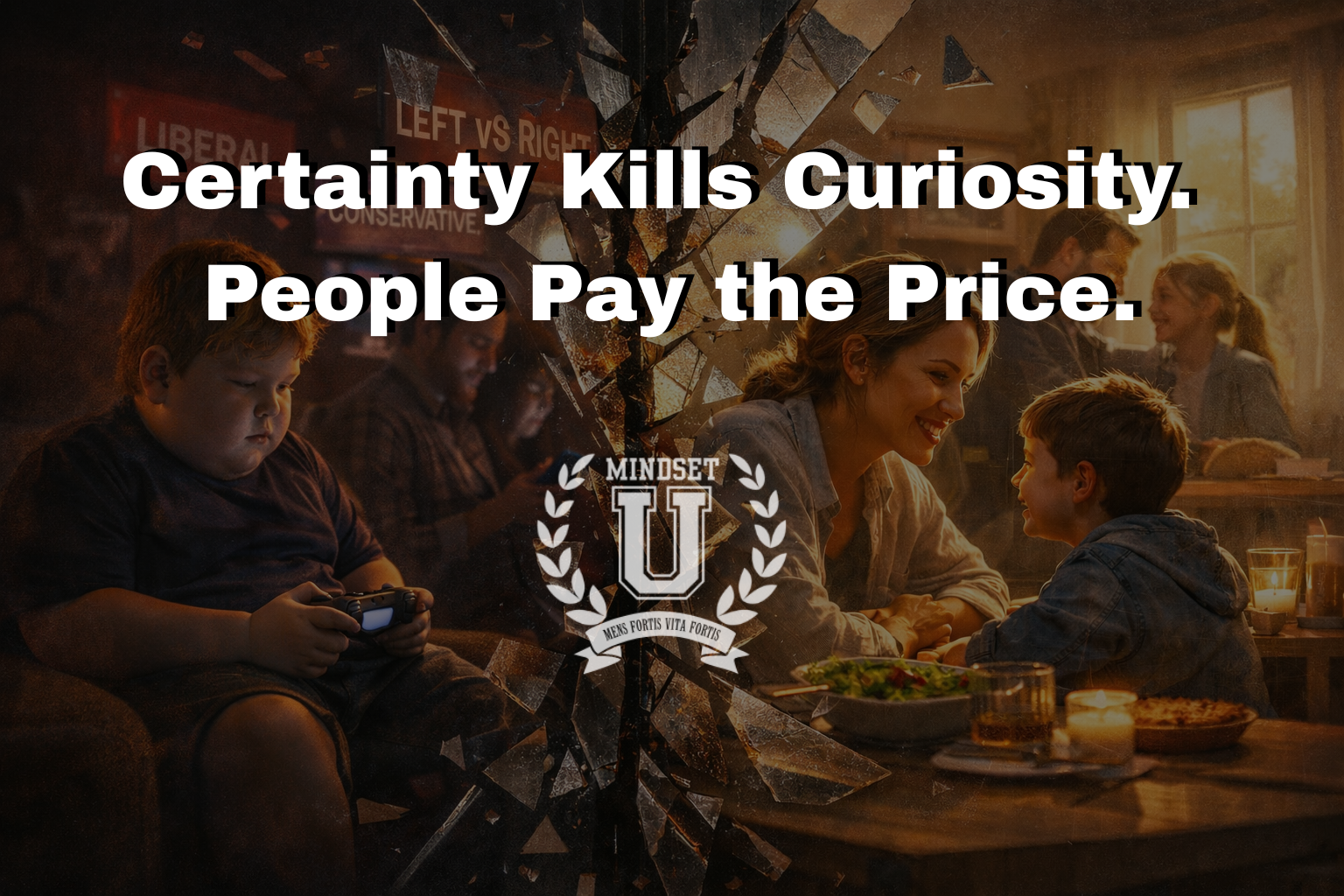
In families who used to sit at the same table and now sit on opposite sides of an algorithm.
And the strangest part?
Most of the damage isn’t coming from deep conversations.
It’s coming from people who didn’t even read the thing they’re reacting to.
Recently, I had someone close to me take a shot at something I wrote… without reading it.
Not a disagreement. A reaction to what they assumed it meant based on a picture.
The distance wasn’t created in that moment. It was already there.
What stood out was how little interest there was in actually understanding what was written.
The post was a month old. No conversation. No context. Just a late swing and a miss at something that was never actually said.
That’s the part worth paying attention to.
Not the disagreement… the interpretation.
We’re Arguing About Symbols, Not Substance
A headline gets read.
A keyword gets spotted.
A label gets assigned.
Left.
Right.
Conservative.
Liberal.
Democrat.
Republican.
Yankees.
Red Sox.
And just like that, the brain shuts the door.
No curiosity.
No context.
No effort to understand what was actually said.
Just reaction.
Here’s what’s actually happening.
The brain is built to save time, not to be right.
It takes two pieces of information that show up close together… and links them automatically.
No instruction. No checking. Just a fast connection.
A word.
A tone.
A label.
“Conservative.”
“Liberal.”
A certain phrase.
That’s enough.
Your brain goes, I’ve seen this before, and fills in the rest.
It doesn’t wait.
It doesn’t ask.
It doesn’t slow down to see if it’s accurate.
Because speed feels like certainty.
And certainty feels like safety.
So the brain locks it in and moves on.
The problem?
That shortcut was built to help you survive, not to help you understand people.
So now you’re not responding to what was actually said…
You’re responding to the meaning your brain assigned to it in a split second.
The brain would rather be fast than right.
It’s not discussion anymore. It’s pattern recognition.
You’re not talking to a person.
You’re talking to the version your brain created.
And most of the time… that version isn’t real.
People Don’t Read. They Defend
Here’s the uncomfortable part.
Most people aren’t forming opinions.
They’re protecting identities.
They’re not asking:
“What is he actually saying?”
They’re asking:
“Does this threaten what I believe?”
And if the answer feels like yes, even slightly, the response is immediate:
Dismiss.
Label.
Attack.
Distance.
No investigation required.
And if you’re honest, you’ve probably done this too.
Read half of something. Assumed the rest. Reacted faster than you understood.
We don’t defend ideas anymore.
We defend the version of ourselves we built around those ideas.
And God help anyone who bumps that scaffolding.
The Illusion of Certainty
Everyone talks like they’ve got insider information.
Like they’re sitting in war rooms.
Like they’ve got top-secret clearance.
They don’t.
They’ve got headlines.
Clips.
Algorithms feeding them more of what they already agree with.
“Well Tucker said this…”
“Wolf said this…”
“CBC said this…”
“Joe Rogan must be right…”
And then the late-night guys…
“Colbert said this…”
“Kimmel joked about this…”
Delivered with a laugh, wrapped as entertainment…
but repeated like it’s fact.
And somehow that turns into confidence.
Not understanding. Confidence.
That’s a dangerous combination.
Because confidence feels like clarity.
It feels like you’ve done the work.
But most of the time, it’s just repetition.
You’ve seen the same angle enough times…
heard the same tone enough times…
watched the same type of clip enough times…
And your brain starts to treat familiarity as truth.
It stops asking questions.
It stops checking.
It starts saying, I already know.
That’s where it breaks.
Because the moment you think you already know…
you stop listening.
You stop being open.
You stop seeing the person in front of you
and start seeing a position you’ve already decided on.
Confidence without depth doesn’t lead to truth.
It leads to division.
Because now you’re not exploring ideas…
You’re defending conclusions.
Look at it honestly
Before you speak on something, ask yourself:
Did I actually look into this…
or did I just see enough to feel certain?
Have I challenged this view at all…
or have I only reinforced it?
Would I be able to explain the other side fairly…
or would I just mock it?
If the roles were reversed,
would I want to be heard…
or dismissed the way I’m about to dismiss someone else?
A simple standard
If you can’t explain the other side without disrespecting it…
You don’t understand your own position as well as you think.
Certainty isn’t the goal.
Clarity is.
And clarity usually comes with a bit of hesitation…
a bit of humility…
and a willingness to say,
I might not have this fully figured out.
That’s not weakness.
That’s the beginning of real thinking.
Meanwhile… Real Life Is Sitting There Unhandled
While people argue about national issues they can’t control…
Their sleep is a mess.
Their health is off.
Their relationships are strained.
Their house is out of order.
Anxiety through the roof.
Short fuse.
Snapping at spouses over nothing.
Kids talking… and not being heard.
But there’s time for debates.
There’s energy for arguments.
There’s passion for proving a point online.
Just not for fixing what’s right in front of them.
It’s easier to talk about governments than it is to look in the mirror.
Easier to argue policy than to admit you’re exhausted, disconnected, and not showing up the way you should.
Easier to scroll, react, and fire off opinions
than to sit in a quiet room and deal with your own life.
Because that requires something most people avoid:
Ownership.
So instead, attention gets outsourced.
To headlines.
To clips.
To people yelling on screens.
And slowly, without noticing…
You start caring more about being right out there
than being present in here.
More invested in winning arguments
than maintaining relationships.
More aware of what’s happening in the world
than what’s happening in your own home.
How’s your nervous system?
Calm… or constantly on edge?
Is your kitchen clean?
Or is everything piling up while your attention is somewhere else?
While you’re drafting your next comment…
arguing with someone you don’t know…
or spiralling about things that may not even exist…
could you be doing something productive?
Could you be adding something of value to your own life…
or someone else’s?
Just a thought.
Because the things being ignored…
Your health.
Your marriage.
Your kids.
Your peace…
Those are the things that actually matter.
Those are the things you can control.
And those are the things that quietly break
while attention is somewhere else.
It feels productive.
It sounds intelligent.
But it’s avoidance.
And avoidance, dressed up as awareness,
is still avoidance.
This Is Showing Up in Families Now
This used to stay online.
Now it’s at dinner.
In kitchens.
On car rides.
In group chats that used to feel easy.
People creating distance.
Pulling back.
Going quiet.
Or worse, taking shots without context.
Tone changes.
Energy shifts.
Conversations get shorter.
Or they stop altogether.
Not because something terrible was said…
But because something was interpreted through the wrong lens.
A word gets flagged.
A phrase feels familiar.
And the brain fills in the rest.
No pause.
No check.
No conversation.
And instead of asking,
“What did you mean?”
We assume.
We assign intent.
We create a version of the person in our head…
and then react to that version like it’s real.
And assumption is gasoline.
It doesn’t clarify anything.
It accelerates everything.
Distance grows quietly.
Not through conflict…
but through lack of conversation.
And the longer it sits,
the more real it starts to feel.
Agreement is optional.
Respect isn’t.
And respect starts with something simple:
Actually hearing what was said
before deciding what it meant.
Here’s the Line I Won’t Cross
I can have a lens.
I can believe what I believe.
I can explore ideas, challenge systems, and think critically.
And I should.
Ideas need to be tested.
They need friction.
They need to be challenged, questioned, pushed on.
That’s how truth gets sharper.
But somewhere along the way…
that got replaced.
Common sense started slipping.
Not all at once. Slowly.
Now everything feels reactive.
Defensive.
Guarded.
Less openness.
Less curiosity.
Less willingness to say, maybe I’m wrong here.
And more attachment to being right.
But none of that…
none of it…
changes how I show up for the people I love.
Family doesn’t get downgraded because of opinion.
Respect doesn’t disappear because of disagreement.
And love sure as hell doesn’t get negotiated based on political alignment.
If it does…
That’s not conviction.
That’s fragility.
Because real conviction doesn’t need to shut people out.
It can sit across from a different perspective,
hear it, challenge it, and still stay grounded.
That’s strength.
What we’re seeing now is the opposite.
Closed loops.
No transparency.
No openness.
Just positions being protected at all costs.
And it’s creating something deeper than disagreement.
It’s creating unnecessary suffering.
Strain where there doesn’t need to be strain.
Distance where there doesn’t need to be distance.
It’s like we’re choosing it.
Choosing tension over understanding.
Choosing certainty over connection.
And then wondering why everything feels fractured.
There’s a better way.
Be clear in what you believe.
But stay open in how you listen.
Be willing to challenge ideas…
including your own.
Because the goal isn’t to win.
It’s to see clearly.
And you don’t get there
by shutting people out.
It’s Everywhere, But That’s Not the Point
Yes, this is happening everywhere.
In Canada.
In the U.S.
Democrat. Republican. Same pattern.
But zoom out too far and you miss the real issue.
This isn’t about countries.
It’s about conversations that never happened.
Questions that were never asked.
And conclusions that were made anyway.
Social Media Isn’t Showing You Reality. It’s Showing You You
This is the part most people don’t want to admit.
Social media doesn’t inform you.
It reflects you.
It studies what you click.
What you watch.
What you react to.
And then it feeds you more of it.
So over time, you’re not seeing the world…
You’re seeing a curated version of your own beliefs being reinforced back to you.
That’s not truth.
That’s a feedback loop.
And if you stay in it long enough, you start thinking everyone who disagrees with you is either stupid or evil.
They’re not.
They’re just watching a different movie.
Some people call it conspiracy.
Others call it common sense.
Either way, you’re still looking through a lens.
Put the Phone Down and Have a Real Conversation
At some point, we have to get back to something simple.
Put the phone down.
Call someone.
Not to prove a point.
Not to win.
Just to understand.
Hear their tone.
Feel their intent.
Ask them what they actually meant.
Because text strips context.
Comments remove humanity.
And headlines kill nuance.
Real conversation brings it back.
Two people sitting at the same table, laying their cards down,
and still passing the potatoes without keeping score.
This is what happens when awareness is low and emotional load is high.
The system reacts before it understands.
And once that happens, the outcome is already compromised.
We don’t have a political crisis.
We have a perception crisis.
And until we start treating the person in front of us
as more real than the filter in our head…
the fractures will keep spreading.
One unread post at a time.